Cub
A one-stop platform for ADHD management
Timeline • Role
April 2023 - Present • Offbeat Media (Mark Cuban-backed startup)
Problem
Over 5% of adults worldwide live with ADHD — and yet the tools they rely on are scattered, generic, and often designed for someone else entirely. Sticky notes. Alarm stacks. A dozen half-used apps. The infrastructure for managing ADHD hadn't caught up to the scale of the problem.
Solution
With Cub, we set out to build a platform that actually fits the lives of young people with ADHD — comprehensive enough to replace the patchwork of tools they were already using, and purposeful enough to reduce stress rather than add to it.
Part 1: Understanding the problem
ADHD spans every age group, which meant our first real product decision was one of focus. Given Offbeat's deep roots in Gen Z marketing and my proximity to the college market, we zeroed in on the 12–25 demographic. I conducted interviews with college students and younger relatives with ADHD, listening for patterns in how they coped day-to-day. What came back was consistent: people weren't using one tool — they were stitching together sticky notes, calendar apps, browser extensions, and handwritten lists just to get through the week. The fragmentation itself was a source of stress. A unified, purposeful platform wasn't just a nice-to-have; for this population, it was the point.
Part 2: Coming up with ideas and solutions
With the market defined, we opened up the problem space. Key features we explored included personalized goal setting, task management and reminders, time-blocking and scheduling, mindfulness tools, structured learning modules, and community support. The goal was comprehensiveness — but without overwhelming a user base that already struggles with cognitive load. Every idea was pressure-tested against one question: does this make the hard days easier, or does it just add more to manage?
Part 3: DECIDING + PROTOTYPING
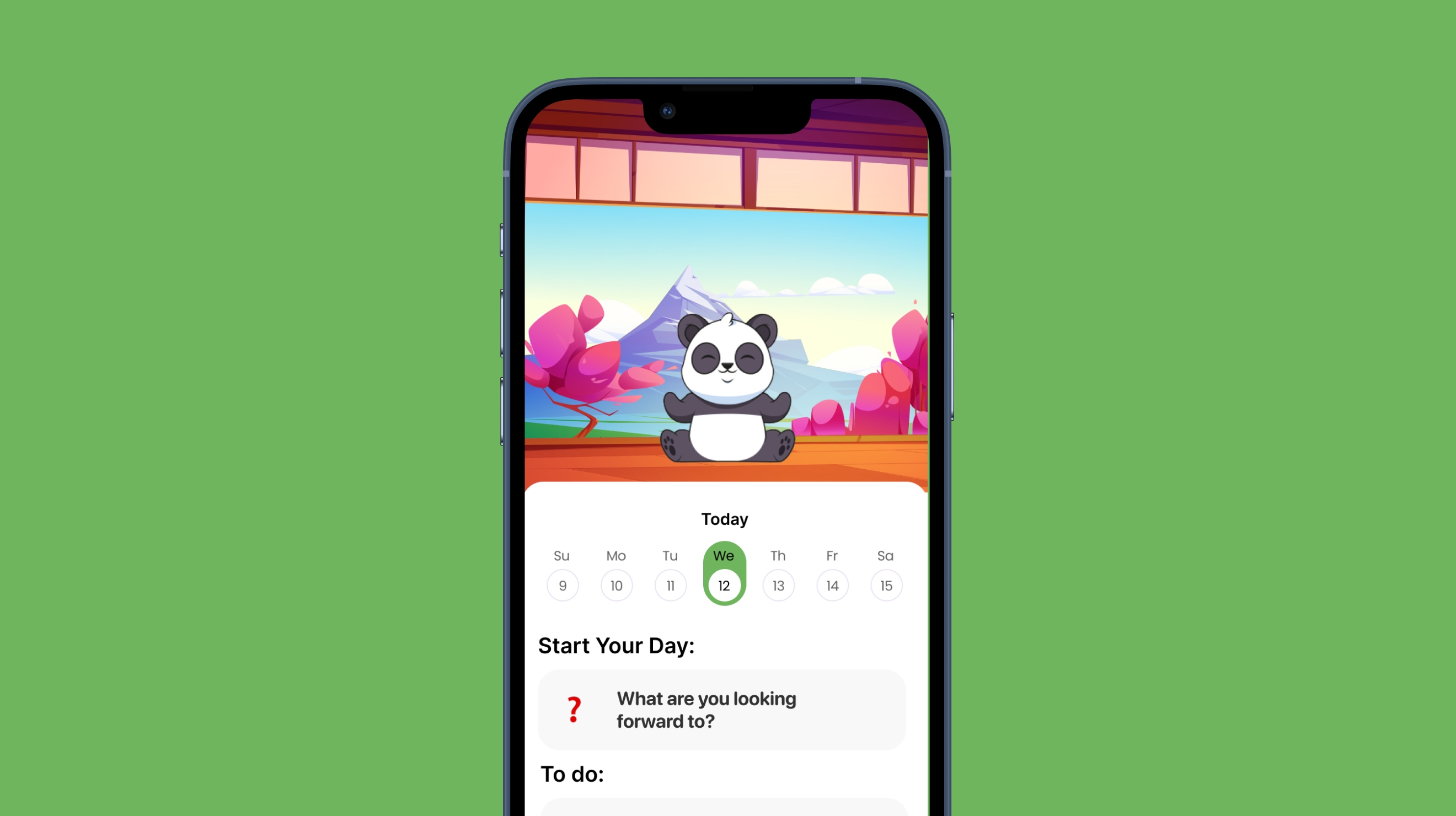
We narrowed the feature set based on feasibility, potential impact, and what users told us actually helped versus what they thought they needed. The interface had to be intuitive enough to use on a hard day. Visually, we made a deliberate choice to center the experience around a character — a supportive panda cub — to inject warmth and strip away the clinical feeling that so many productivity tools carry. The design language needed to feel like a companion, not a system.
Part 4: ROUND OF TESTING AND IMPROVEMENTS
We brought the prototype back to the people I'd interviewed from the start. Watching real users navigate the app surfaced friction we hadn't anticipated — particularly around onboarding and habit formation. Through several rounds of iteration, three design principles crystallized: gamified progress tracking to make consistency feel rewarding, daily focus challenges to give users a clear entry point each morning, and expert insights embedded contextually rather than buried in a resource library.
Reflections
Cub taught me that great product design for a vulnerable population means ruthlessly prioritizing simplicity — not because users can't handle complexity, but because they shouldn't have to fight the tool on a hard day. The most impactful features were often the ones we removed. Building with empathy isn't just a design value; it's a product strategy.