Abstract
Quick and fun daily news digests for people who won't read the news
Timeline • Role
June 2023 - August 2023 • Solo project
Problem
Staying informed is supposed to feel like a civic good. It mostly feels like homework. Traditional news platforms are dense, algorithmically anxious, and designed to maximize time-on-site rather than actual comprehension. For a generation that grew up with TikTok and meme culture as information formats, the standard news experience isn't just boring — it's a different language.
Solution
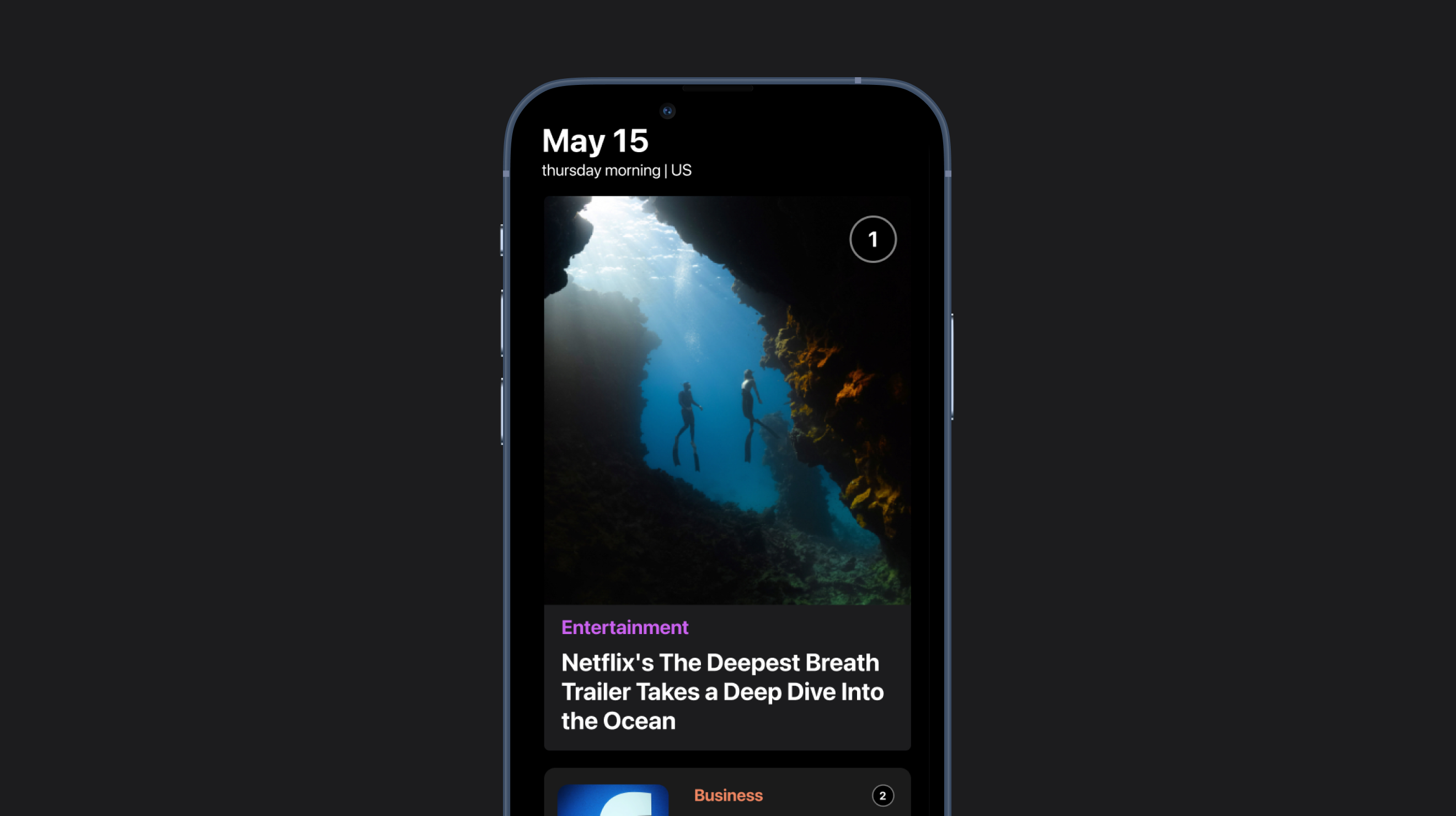
Abstract delivers the essential US stories of the day in a single morning digest — fast, visually dynamic, and built for the way younger readers actually consume content. The news itself isn't the problem. The packaging is.
Part 1: Understanding the problem
I interviewed college students across my network about how they kept up with current events. The findings were pointed: most had abandoned traditional news publishers entirely, citing both perceived bias and sheer tedium. Instead, they were cobbling together their understanding of the world from Instagram meme accounts, Snapchat Discover, and whatever surfaced on their social feeds. The demand for being informed hadn't gone away — but the tolerance for legacy formats had. They wanted something fast, trustworthy, and at least a little fun.
Part 2: Coming up with ideas and solutions
I mapped the best parts of what was already working — the brevity of Quartz, the visual energy of Snapchat Discover, the cultural fluency of Twitter — and looked for what was missing at the intersection. The brief I set for myself: once a day, in the morning, deliver the top US stories in a format that respects your time and your intelligence without putting you to sleep. Combining the best of meme-culture brevity with structured, reliable journalism became the design north star.
Part 3: DECIDING + PROTOTYPING
The core design challenge was hierarchy and rhythm. How do you present five or six distinct stories in a way that feels cohesive but doesn't blur together? I looked at Quartz, Yahoo Daily Digest, Snapchat, and Twitter as references — studying not just what they looked like but why certain layouts created momentum and others created friction. Several structural approaches were tested before the right system emerged.
Part 4: ROUND OF TESTING AND IMPROVEMENTS
Three choices defined the final product. First, modular 'news blocks' — self-contained story units that communicated the essential facts at a glance but expanded for readers who wanted more context. Second, a countdown to tomorrow's digest — a deliberate piece of FOMO design that gave users a reason to come back the next morning. Third, color-coded topic categories that allowed at-a-glance orientation across stories, reducing the cognitive work of navigating a new edition.
Reflections
Abstract reinforced something I keep coming back to in product work: the best interfaces disappear. When the design is working, users don't notice it — they just feel informed and strangely glad they opened the app. Keep designs as simple and digestible as possible, and always start from first principles: what does this person actually need to accomplish here, and what's getting in the way of that?